

Next-Gen Access Control Hardware for Automated Spaces: RFID, QR Code & BLE Integration
The Rise of Unmanned Rental Spaces and Critical Access Management Challenges
Unmanned rental spaces and self-service facilities are rapidly expanding globally, optimizing operational overhead while empowering users to book and access spaces instantly via cloud platforms or mobile apps. However, managing security for automated properties introduces several vulnerabilities that System Integrators (SIs) and property managers must resolve:
- Preventing Unauthorized Intrusion: How to strictly block non-authorized personnel from accessing restricted zones.
- Time & Zone Restraints: How to enforce precise schedules and location-based boundaries for individual users.
- Dynamic Credential Lifecycles: How to seamlessly issue and revoke flexible access rights for diverse cohorts (short-term tenants vs. long-term staff).
- Mitigating Security Risks: How to control operational vulnerabilities such as tailgating, unlatched doors, or the security risks of compromised static pin codes.
Overcoming these bottlenecks requires high-reliability, intelligent access control hardware engineered specifically for automated environments.
How Automated Spaces Reshape Access Control Hardware Requirements
Unlike static corporate office setups, automated and unmanned spaces require edge devices that scale rapidly and interface smoothly with third-party software layers:
- Multi-Credential Authentication: Native support for QR Codes, RFID cards, and mobile Bluetooth (BLE) to deliver maximal deployment flexibility.
- Real-Time Audit Trails & Remote Monitoring: Immediate hardware-level logging of access data, forced-door alerts, and door-ajar events for centralized cloud management.
- Dynamic Permission Control: Edge-level execution of one-time, time-restricted, or recurring authorization schedules.
- Scalable Hardware Footprints: Form factors engineered to fit seamlessly across diverse physical deployments—from micro-drawers to perimeter building gates.
These rigorous technical criteria align closely with modern deployments in smart buildings, residential complexes, automated hospitality, and commercial security ecosystems, driving hardware engineering toward deeper integration capability.
The Evolution of Smart Access Control Controllers
To address the specialized needs of automated deployments, access control hardware must feature robust connectivity and multi-device interoperability. Key hardware architectures include:
1. QR Code & RFID Integrated Controllers
Features dual-credential verification (optical scanning and RF induction), making it the ideal hardware backbone for co-working spaces, automated lodging, and multi-tenant rental venues.
Featured Hardware Backbone: PQ-3702 QR Code & RFID Networked Controller
- Broad protocol compatibility: Supports EM, H.I.D., Mifare, Felica, and NFC formats.
- Edge-level processing: Supports dynamic QR code parsing and onboard audit trail storage.
- Engineered for mobile-first deployments and secure contact-free entry systems.
2. Multi-Modal Authentication Controllers
Combines PIN pad, card induction, and multi-factor modes (Card + PIN) to protect specialized containment areas like secure mailboxes, multi-tier floor access, and storage lockers.
Featured Hardware Backbone: PP-33 Touch Keypad Networked Controller
- Industrial reliability: Built with an IP54-rated weatherproof housing.
- Advanced edge security: Supports single-door bidirectional control and native anti-tamper circuitry.
- Delivers robust hardware versatility for elevator control and secure smart facility deployments.
3. Bluetooth (BLE) & Time-Attendance Access Controllers
Seamlessly bridges smartphone-based BLE credentialing, optical QR codes, and a physical LCD interface for real-time tracking, perfect for high-traffic entry points and commercial office suites.
Featured Hardware Backbone: PP-6750V Bluetooth Time Attendance Recorder & Access Controller
- High-capacity mobile pairing: Supports concurrent authentication for multiple smartphone credentials.
- Proactive risk mitigation: Equipped with integrated alarm outputs and onboard tamper detection for high-security management.
4. Ultra-Compact Standalone Edge Controllers
Engineered for decentralized deployments, operating entirely independent of local PC networks. Perfectly sized for integration into safety deposit boxes, secure drawers, or behind elevator panels.
Featured Hardware Backbone: PC-30 Mini Standalone Controller
- Dual-frequency versatility: Simultaneous support for legacy and high-security RFID protocols.
- Precision hardware execution: Features variable VR-configurable delay outputs to secure specialized, micro-scale spaces where long-range readers are impractical.
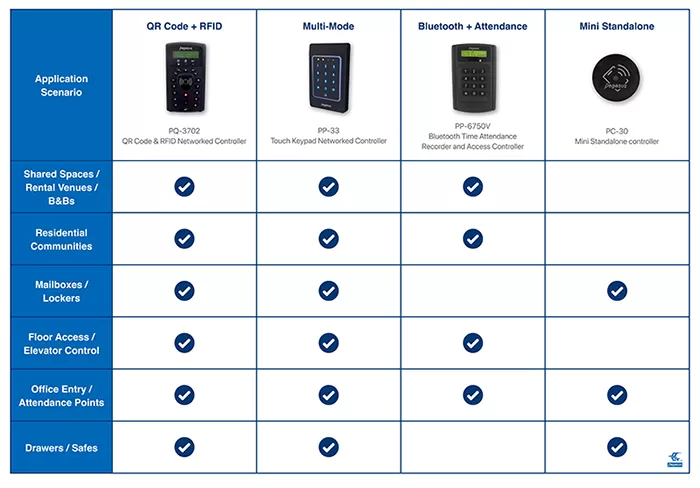
Leveraging these specialized hardware tiers ensures that System Integrators can deploy an uncompromised security framework across any automated property layout.
How to Select the Right Access Control Hardware
Before finalizing hardware procurement for your next deployment, we recommend benchmarking your project scope against these technical evaluation criteria:
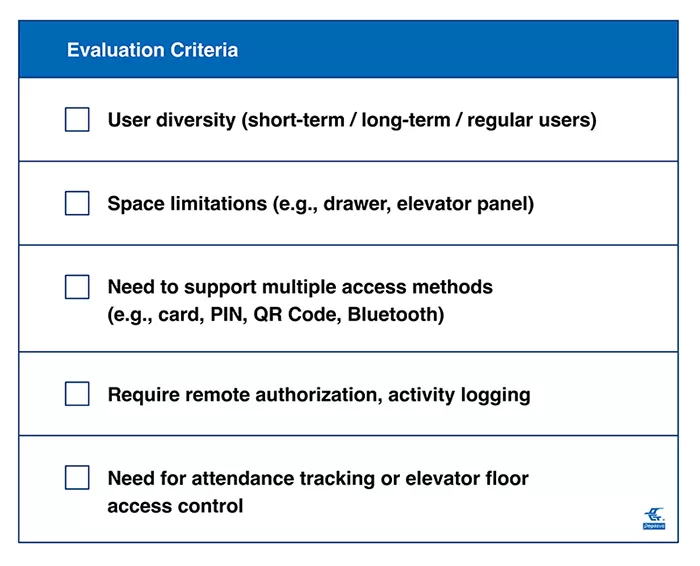
Hardware Selection & Deployment Benchmarks:
- Baseline Security Deployments (1–2 Criteria Matched): Optimize costs with decentralized, space-saving standalone units such as the PC-30, ideal for individual lockers, key cabinets, or basic entry points.
- Advanced Networked Infrastructures (3–4 Criteria Matched): Deploy robust networked controllers like the PP-33 or PQ-3702 to enable remote management, multi-tier RFID authorization, and elevator integration.
- High-Tier Multi-Modal Integration (5+ Criteria Matched): Standardize on full-featured enterprise controllers like the PP-6750V to unify time-attendance tracking, BLE mobile access, and dual-mode unlocking on a single hardware platform.
Whether managing commercial smart buildings, residential complexes, or unmanned self-storage networks, PONGEE provides modular, highly scalable hardware building blocks backed by extensive factory OEM/ODM customization capabilities for international multi-site rollouts.
Future Industry Trends & Manufacturer's Insight
In the modern security ecosystem, access controllers have transcended their traditional role as simple relay switches. They now function as intelligent edge devices responsible for local data processing, encrypted authentication lifecycles, and systemic hardware integration. Moving forward, the technical evolution driven by leading hardware manufacturers will center on:
- Advanced Mobile & Cloud Synchronization: Deeper integration of secure BLE virtual tokens, NFC-enabled wallets, and cloud-provisioned credentials.
- Edge Intelligence & Autonomous Operation: Enhancing edge-level database capacity to guarantee uninterrupted automated access logic and anti-tamper security even during complete network disconnections.
As a dedicated security hardware manufacturer with 42 years of technical expertise in Taiwan, PONGEE remains committed to pioneering high-reliability RFID, Bluetooth, and QR Code hardware. We provide the robust, scalable components that System Integrators require to seamlessly transition any space into a secure, automated environment.
Partner with PONGEE for Your Next Deployment
For tailored technical specifications, high-volume production, or dedicated OEM/ODM engineering support, contact our factory team directly:
- Phone: +886-2-8228-0198
- Email: pongee@pegasus.com.tw
- Headquarters: 5F., No.738, Chung-Cheng Rd., Chung-Ho District, New Taipei City 235603, Taiwan