
Where Is Mobile NFC Commonly Used? Why Enterprise Access Control, Industrial Equipment, and OEM Projects Rarely Use It as the Core Solution
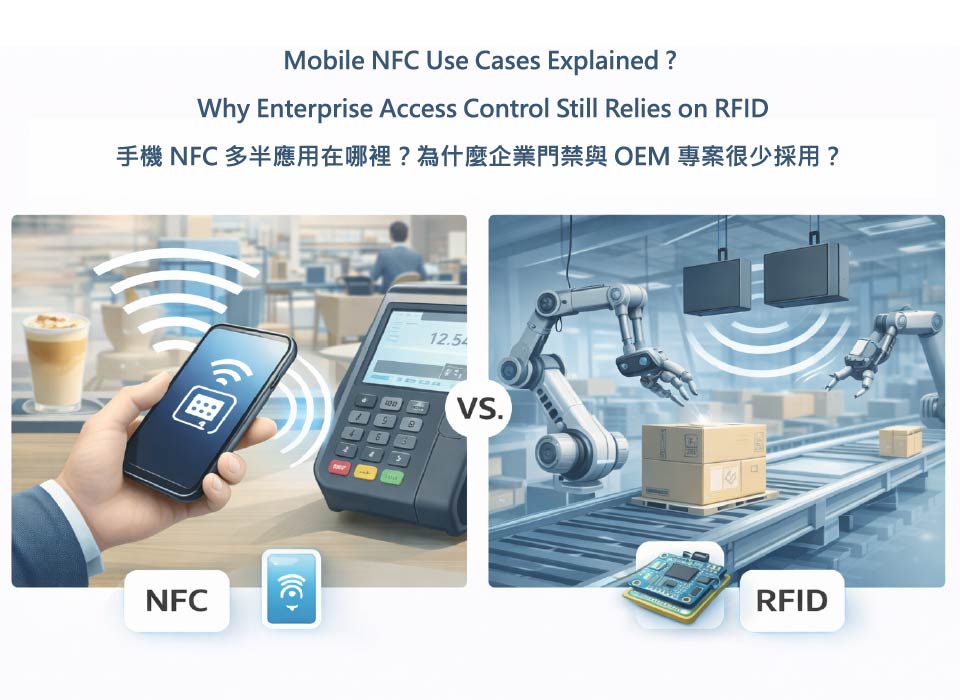
Why Mobile NFC Appears Versatile but Has Practical Limitations
With the widespread adoption of smartphones, NFC has become part of everyday consumer life. From mobile payments to transportation cards, its convenience leads many to assume that mobile NFC could replace all access control and equipment systems.
In practice, however, mobile NFC and industrial RFID modules serve fundamentally different system objectives and design philosophies.
Primary Application Areas of Mobile NFC
Mobile Payments and Consumer Ticketing
The most mature and successful applications of mobile NFC are in consumer payment scenarios, including:
- Mobile wallets (Apple Pay, Google Pay)
- Transportation and membership cards
- High-frequency, low-risk transactions
These environments typically prioritize:
- User experience
- Convenience over strict control
- Platform and ecosystem integration
Consumer Access Control and Smart Living
Mobile NFC is also used in:
- Residential access systems
- Smart locks
- Short-term rental and apartment management
These scenarios generally tolerate platform dependency and user-driven device changes, while often retaining physical cards as backup.
Short-Term and Temporary Identification
Mobile NFC is well suited for:
- Event access passes
- Visitor credentials
- Temporary authorization
These applications do not require long-term maintenance or strict operational control.
Device Pairing and Initialization
In IoT and consumer electronics, NFC is commonly used for:
- Fast device pairing
- Initial setup processes
- One-time identity exchange
Once configuration is complete, NFC no longer plays a role in system control.
Why Mobile NFC Is Rarely the Core in Enterprise and OEM Systems
Smartphones Are Not Fully Controllable Credentials
Enterprise and industrial systems require credentials that are:
- Issued, revoked, and audited centrally
- Predictable and consistent
- Independent of personal device status
Smartphones, as personal devices, cannot fully meet these requirements.
Long-Term Stability Is Critical in Industrial and OEM Projects
Industrial and OEM systems typically operate for:
- 5–10 years or longer
- Without frequent architecture changes
- Independent of single-platform ecosystems
Mobile NFC capabilities depend heavily on operating systems and platform policies, which may change over time.
Non-Human Operation Scenarios
Many RFID systems are operated by machines rather than people, such as:
- Industrial equipment authorization
- Machine safety and misuse prevention
- Medical device identification
- Automated production workflows
In these scenarios, mobile NFC is impractical, while embedded RFID modules provide reliable solutions.
Consistency Over User Experience
Enterprise access control and industrial systems prioritize:
- Consistent response behavior
- Low error rates
- Predictable operation
Mobile NFC’s user experience advantages may introduce variability rather than stability.
The Appropriate Role of Mobile NFC in Enterprise Systems
Mobile NFC is best positioned as:
- A supplementary access option
- A visitor or temporary credential
- An added convenience for specific user groups
It is rarely designed as the sole authentication mechanism.
Conclusion: Different Technologies for Different Design Philosophies
Mobile NFC excels at human-centric service experiences, while RFID modules excel at system-centric control and long-term operational stability.
This is why mobile NFC is rarely the core solution in enterprise access control, industrial equipment, and OEM projects—not due to technical inferiority, but because the underlying design goals differ fundamentally.
Actual system planning should be evaluated based on project environment, application requirements, regulatory constraints, and overall system architecture. This article provides general technical decision logic and selection references to clarify the role of mobile NFC in enterprise and industrial implementations.